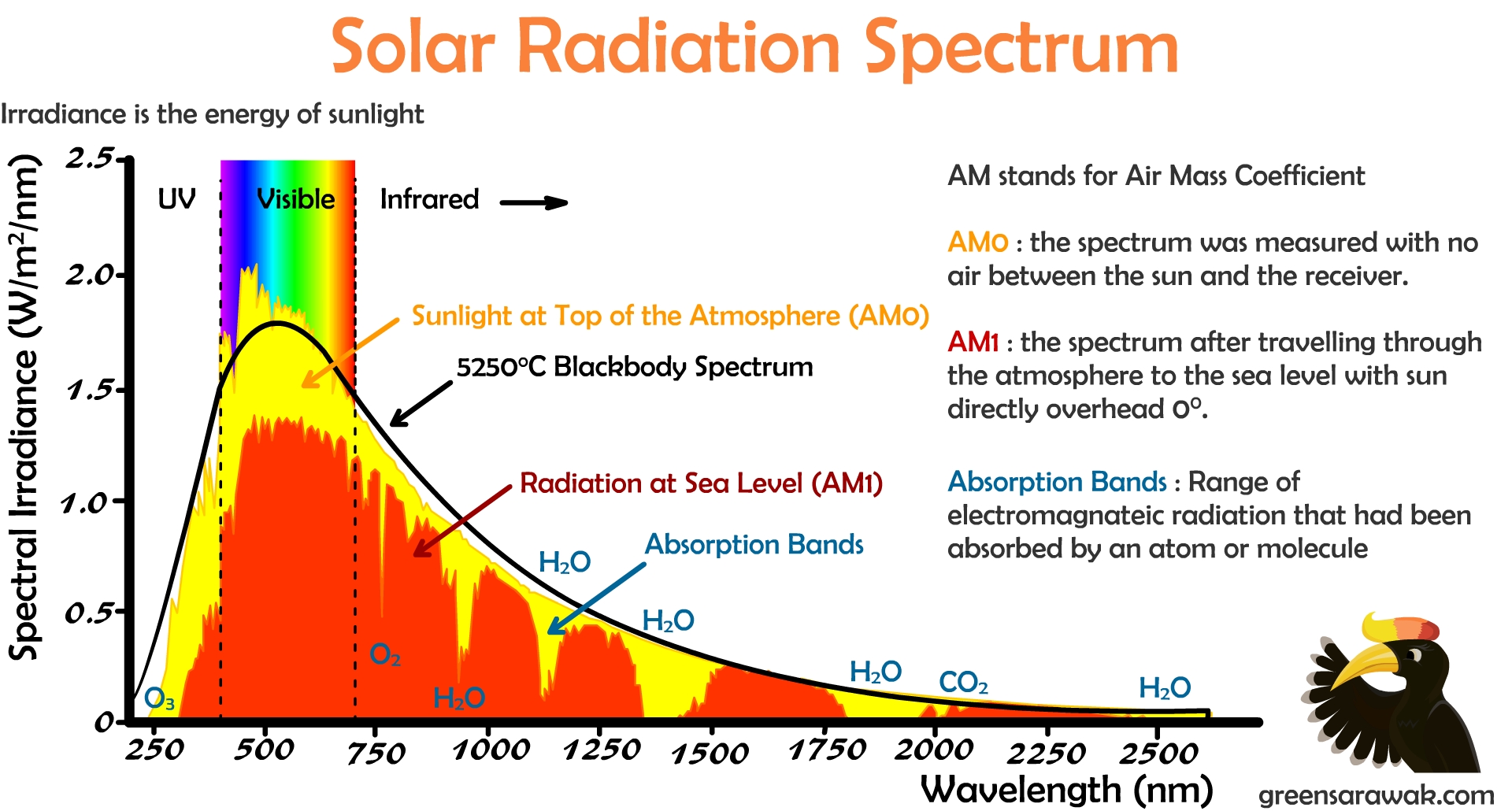
Solar radiation undergoes various scattering and absorption before it reaches the earth directly, and it is said that the wavelength range of about 300 to 3,000 nm is direct light radiation. This radiation is roughly classified into three types, called ultraviolet radiation, visible radiation, and infrared radiation. The range of visible radiation required for human vision is 380 to 780 nm, and the peak of luminosity factor (photopic vision) is at 555 nm. Plants also have a range of physiologically required radiation. On the other hand, there are two types of radiation that are effective for plants: Physiologically Active Radiation and Photosynthetically Active Radiation (PAR). Physiologically effective radiation is in the wavelength band of about 300 to 800 nm, and is said to have some physiological effects such as photosynthesis, pigment biosynthesis, photoperiodism, phototropism, and morphology 1). Physiologically effective radiation has 5 bands according to action (300 to 400 nm is near-ultraviolet light = UV, 400 to 500 nm is blue light = B, 500 to 600 nm is green light = G, 600 to 700 nm is red light = R, 700-800 nm is classified as far red light = FR (Far Red)). Photosynthetically active radiation (PAR) requires strong light intensity because it is within the wavelength range of physiologically effective radiation (400 to 700 nm) and is an energy source for plant growth. Since the unit is different from the human eye, illuminance (lux) is not used professionally. Since it is through a photochemical reaction, it is represented by a total photon bundle within the wavelength range. In this case, the energy radiated from the light source is called Photosynthetic Photon Flux (PPF). On the other hand, the energy received by plants is called Photosynthetic Photon Flux Density (PPFD) and is represented by μmoℓ ・ m⁻² ・ sec⁻¹ in the SI unit system. It is also said to be consistent because moℓ units are used in related gas exchanges.